Sunshine and Vitamin D

Did you know that Vitamin D
does all this?
- Helps produces natural antibiotics that help increase our resistance to flu, colds, HIV, etc.
- Helps maintain mineral balance inside cells, including inside the mitochondria. Minerals are rate limiters in regard to production of mitochondrial antioxidants that cope with free radical creation in the mitochondria, so having enough is vital to mitochondrial health.
- Helps prevents arterial calcification or hardening of the arteries — helping decrease blood pressure, increasing cardiac output and lowering resting heart rate.
- Is a lipid antioxidant, helping lower cholesterol and providing more cellular membrane protection than Vitamin E.
- Helps prevent autoimmune disease, such as MS, Lupus, etc.
- Help to promote strong bones and helps prevent fractures.
- Helps increase muscle strength, tolerance to stress, sex hormones, energy and endurance.
|
|
There is a reason that November is historically the healthiest month of the year (in the Northern Hemisphere). The reason is that our bodies have been accumulating (during the spring, summer and fall months) Vitamin D, the Sunshine Vitamin, so that Vitamin D reaches its highest yearly level in the body in October.
Contrastingly, the unhealthiest months of the year are January through April because by then body levels of Vitamin D have diminished and are not being renewed by exposure to sunshine.
Vitamin D — Paramount Chemical Messenger
 The reason Vitamin D is called the sunshine vitamin is because when rays of sunlight penetrate one’s skin, Vitamin D is created within the skin. A plethora of studies demonstrate categorically that Vitamin D is one of our body’s most important nutrients, furnishing the health benefits listed in top, right box. The reason Vitamin D is called the sunshine vitamin is because when rays of sunlight penetrate one’s skin, Vitamin D is created within the skin. A plethora of studies demonstrate categorically that Vitamin D is one of our body’s most important nutrients, furnishing the health benefits listed in top, right box.
Vitamin D is almost as vital to life as is oxygen. And so, with the sole exception of oxygen, it is impossible to find something that is more important to talk about in the field of health than Vitamin D. When Vitamin D is in optimal supply in the body, significant wellness benefits result and when Vitamin D is not in plentiful supply, numerous health woes are on their way.
Low Vitamin D and Degenerative Disease are Linked
There is an extremely high degree of correlation between Vitamin D levels and degenerative disease. Medical scientists and researchers have found that serum Vitamin D levels are low in 90% of people with degenerative disease such as heart disease, cancer and autoimmune disease.
Scientific researchers have assembled data showing that autoimmune diseases and cancer are largely absent from areas close to the equator. These scientists believe that this is because the angle of the sun is more direct near the equator and therefore stimulates a comparatively much larger production of Vitamin D in the human body than in areas further from the equator.
Low Vitamin D and Colds and Flu are Linked
Scientific studies show conclusively that one is much less likely to get sick with colds or flu when his/her body ample Vitamin D. That’s why sickness is more prevalent during the later winter months when people have less exposure to sunshine and less accumulated Vitamin D in their bodies. Fortunately, for those who understand the importance of Vitamin D, Vitamin D supplements can furnish much the same rewards as sunshine.
Serum Vitamin D Levels Can Predict Your Health
There is so much scientific evidence documenting the essential health roles of Vitamin D, showing that ill health corresponds to low levels of Vitamin D that for one to not ensure optimal intake of Vitamin D is foolhardy. Going without Vitamin D for an extended period of time will result in cellular membrane damage that is not easily undone. Truly, an ounce of prevention is worth a pound of cure.
Problem: The majority of people today in industrialized nations are under supplied with Vitamin D, usually getting 10 to 20 times less Vitamin D than their bodies could use. The average North American diet furnishes only 200 to 250 units of Vitamin D daily as opposed to an optimal intake of at least 4,000 units.
What Are Adequate Serum Levels of Vitamin D
There are two measuring systems for reporting Vitamin D levels in the body. With the first method, optimum serum Vitamin D levels are between 125 to 200 nanomoles per liter, and with the second scale, 50 to 80 nanograms per milliliter.
Using the first measuring scale, lifeguards and farmers have average serum Vitamin D levels of 165 and 130 nanomoles, respectively (66 ng/ml and 52 ng/ml in the second scale). But, the rest of us in North America and Europe are almost always below 75 nanomoles per liter (or 30 ng/ml). In fact, the majority of North Americans and Europeans are below 40 nanomoles per liter (10 ng/ml) and a very significant number are below 20 nanomoles per liter.
We recommend that everyone read one or more of the Vitamin D reference articles listed at the end of this page. You may be astounded by what you learn.
Unfortunately, some people may think that they are getting enough Vitamin D through the diet, but the truth is that sunshine and supplements are far required. Food is deficient as shown in the below chart.
|
Food
|
Amount
|
Equivalent to
|
|
Milk 8–ounce glass, fortified
|
100 IU
|
45 seconds of sunshine
|
|
Whole egg
|
20IU
|
8 seconds of sunshine
|
|
Butter, 1 tablespoon
|
8 IU
|
3 seconds of sunshine
|
|
Fish, canned or fresh
|
200 - 400 IU
|
1 to 3 minutes of sunshine
|
|
Cod Liver Oil, tablespoon
|
1,360 IU
|
8 minutes of sunshine
|
|
Average American Diet
|
200 - 250 IU
|
1 to 2 minutes of sunshine
|
|
|
|
 Our bodies were designed to get Vitamin D from sunshine. Our bodies were designed to get Vitamin D from sunshine.
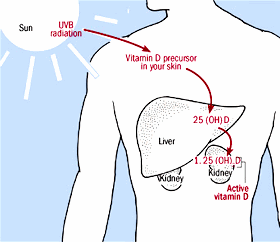 As direct sunlight reaches the skin (similar to plant photosynthesis), Vitamin D precursors are created in the skin tisssue in large quantity and then converted by the liver and kidneys to the active form of Vitamin D known as Vitamin D3. As direct sunlight reaches the skin (similar to plant photosynthesis), Vitamin D precursors are created in the skin tisssue in large quantity and then converted by the liver and kidneys to the active form of Vitamin D known as Vitamin D3.
Just 1/2 hour of daily, mid-day, full-body sunshine in Florida or other tropical latitudes will get a person all the Vitamin D his or her body needs. The problem is that many of us don’t get that much mid day sunshine on our skin in a month, let alone each day.
Factors that interfere with the human body’s ability to make Vitamin D include:
- The further we are from the equator, the more difficult it is to get enough Vitamin D from the sun. At the equator, full body exposure to sunlight produces up to 20,000 units of Vitamin D per hour (depending on skin complexion - fair skin produces the most Vitamin D). If, however, one is more than 30 degrees north or south of the equator it can take from two to ten times longer to get Vitamin D from sunshine.
- Sun blocking lotions prevent people from getting Vitamin D from the sun. Anything over an SPF 8 all but stops Vitamin D production. A good practice is to go in the sun for 15 to 30 minutes before applying sunblock, so you get Vitamin D from the initial sun exposure, but don’t burn.
- Sunlight is most effective at producing Vitamin D between 10:00 AM and 2:00 PM. After that the angle of the light isn’t direct enough to stimulate as much production of Vitamin D.
- The darker one’s skin the more exposure to sunlight is required for the production of Vitamin D. This is due to the melanin stopping the penetration of the UV rays that stimulate Vitamin D production. Dark skinned people need 10 to 20 times more exposure to sun to produce the same amount of Vitamin D in the skin. Therefore, darker skinned people need to consider supplemental Vitamin D3 unless they are in the sun many hours per day.
Our educational system needs to teach the critical role of Vitamin D in human health.
Most people have been taught in their health education classes at school that minimal doses of Vitamin D prevent rickets. Hopefully, some day, health education classes will teach that larger amounts of Vitamin D from sunshine or supplements, not only help make strong bones, but also help create a strong immune system and generally promote good health.
Vitamin D3 supplements are a good alternative to getting Vitamin D from sunshine.
By now you may recognize your need to supplement with Vitamin D. In choosing a supplement, you should choose Vitamin D3 supplements since Vitamin D3 is the active form of Vitamin D and the most efficient form for the body. Vitamin D2 has to be converted to Vitamin D3 by the body.
Supplementation with Vitamin D3 is:
- Inexpensive
- Well absorbed
- Furnishes exactly the same chemical as what we would get from sun exposure
There isn’t much of an excuse for not getting sufficient Vitamin D. We can go outside and get sunshine for free or buy the sunshine vitamin for less than 20 cents a day.
Research now shows that daily doses between 4,000 and 6,000 units are desirable for most average sized adults (who don’t otherwise get Vitamin D) to consume on an ongoing, daily basis. Many believe that even higher levels can be taken safely — as much as 30,000 units daily for up to a month or even longer in order to help strengthen the body’s ability to fight off illness. Even hundreds of thousands of units of Vitamin D may be used in therapeutic doses to quickly bring up serum blood levels of Vitamin D. This, however, should only be done for a short period of time, as it is possible to get too much Vitamin D with continued high doses.
Many wellness experts recommend that when one starts to come down with a cold or flu, it is a good idea to increase one’s intake of Vitamin D to as much as 20,000 units per day for a few days.
You can buy Vitamin D at low cost from Amazon.com. ($8.00 for 60 capsules of 5,000 units of Vitamin D3. That’s a two month supply, so the cost is less than 15 cents a day. There is nothing one can do that is better for one’s health at such a low cost.
Cited Vitamin D Research and Further Vitamin D Study References:
|