Good Bacteria
Keeping our Large Intestine (Colon) and Small Intestines Well Stocked with Protective Bacteria is a Very SMART Practice!
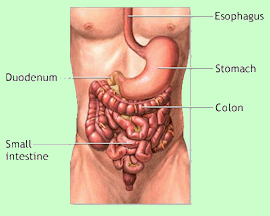 Many wellness experts have taught that making sure one’s intestines are in good shape and well stocked with protective & cleansing bacteria is the single most important health practice that a person can have. Many wellness experts have taught that making sure one’s intestines are in good shape and well stocked with protective & cleansing bacteria is the single most important health practice that a person can have.
The reason is that protective bacteria fight harmful bacteria, which are the # 1 villain of human health. Harmful bacteria are the common element in the below hugely important sanitation practices:
- Removing sewage from living quarters.
- Ensuring that drinking water is not contaminated with sewage.
- Washing hands after toilet visits.
The above practices have the purpose of keeping harmful bacteria away from people.
As much as we laud doctors, hospitals surgeries and the whole gamut of modern medicine, unsung sanitation engineers have saved more lives than all the hospitals and doctors throughout all history combined. Mahatma Ghandi is reported to have said, “Sanitation is more important than independence.”
It follows that after ensuring external sanitation, making sure that our internal sanitation has a high priority so that our own personal sewage system (our intestines) does not become a factory for breeding harmful bacteria inside our own bodies is of paramount importance.
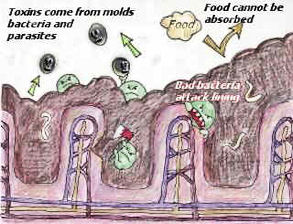
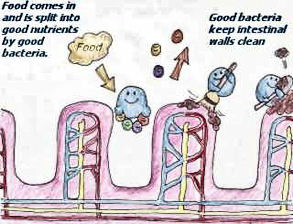
Please study the two pictures below (villi in our small intestines). It is paramount that our intestines function as in the picture on the right with protective bacteria in place to keep them clean.
We must be vigilant that our intestines (colon and small intestines) are well populated by protective bacteria so that our intestinal linings are clean and undamaged.
There are two extremely important factors about our intestines:
- The intestines need to be maintained free of mucoidal gel and harmful bacteria or else the intestines will become a factory for the creation of bacterial exotoxins and other noxious molecules that may enter our blood stream in the amount of billions of molecules per day.
- It is vital the intestines be maintained without holes in the intestinal walls that would allow bacteria and other pollutants to enter the blood stream. These holes are caused by microorganisms - fungus, parasites and harmful bacteria.
Protective Bacteria Oppose Harmful Bacteria and Fungus
The most important factor for maintaining a clean intestinal tract is to grow friendly bacteria (protective or good bacteria, also called probiotics) in our intestines. These good bacteria compete with harmful bacteria and yeast in our gut.
Maintaining healthy bacteria in order to keep out the bad microorganisms is kind of like growing a healthy lawn. The best way to keep weeds out the front lawn is to have healthy grass growing first, taking up all of the lawn space so that weeds cannot get started.
Good bacteria do much more, however, than just take up space. Protective bacteria also function somewhat like afterburners on jet engines. They interact with the food passing through our intestines to create additional valuable nutrients that are released into our blood stream. For instance, good bacteria produce additional B-Vitamins and chemicals that protect our bodies from cancer and tumor formations.
A healthy human colon should contain over four pounds of protective bacteria. The ratio of protective bacteria to harmful bacteria should be high, at least 80% protective bacteria to 20% harmful bacteria. Unfortunately, in many people this ratio is reversed, with the result that harmful chemicals are constantly entering the blood stream and toxifying the body.
Some of the reasons that the ratio of protective to harmful bacteria gets lopsidedly wrong include:
- Using antibiotics to combat infections. Antibiotics kill off BOTH protective and harmful bacteria. Unfortunately, the harmful bacteria grow back faster and will soon dominate the intestines. Every single time antibiotics are used, one needs to very purposefully repopulate the intestines with protective bacteria.
- Mercury in our dental fillings leaks into the body and kills off good bacteria in the gut. And, again, the harmful bacteria grow more quickly than the protective bacteria and take over the intestinal tract. Anyone who has mercury fillings is releasing mercury every time they chew food. Therefore, a program for constantly repopulating the intestines with protective bacteria is needed.
Recommended Protective Bacteria Products
Reference Material
http://www.actionbioscience.org/biodiversity/wassenaar.html
http://nposonline.net/water-sanitation.shtml
http://www.earthlife.net/prokaryotes/disease.html
http://www.medicalnewstoday.com/articles/26631.php
|